
COURSE OBJECTIVES
To introduce the concepts of compressibility.
To make the student understand the theory behind the formation of shocks and expansion fans in Supersonic flows.
To introduce the methodology of measurements in Supersonic flows.
UNIT 1 CONCEPTS OF COMPRESSIBLE FLOW 9 Hrs.
Basic concepts of compressible flow, Review of continuity, energy and momentum equations. One dimensional inviscid flow; Stagnation quantities; Isentropic conditions. Speed of sound and Mach number; Isentropic relations; Area-velocity relation. Flow through constant area duct.
UNIT 2 COMPRESSION AND EXPANSION WAVES 9 Hrs.
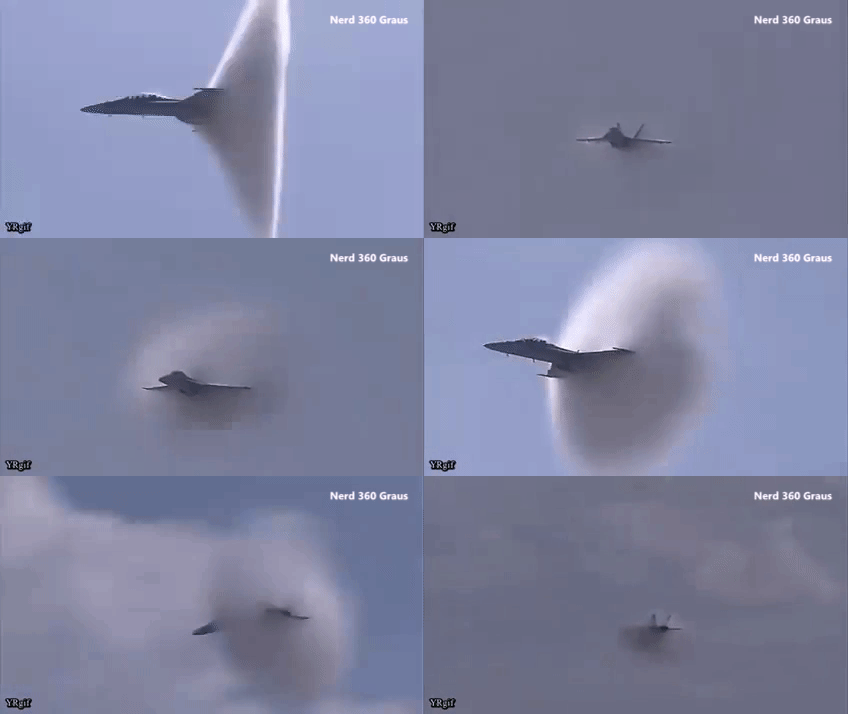
Normal shock –Prandtl equation and Rankine–Hugonoit relation .Oblique shock and supersonic compression by turning. Weak shocks and Mach waves; Super sonic expansion by turning. Prandtl-Meyer expansion fan; Reflection and intersection of shocks. Shock detachment and bow shock; Shock Expansion theory with application to thin airfoils.
UNIT 3 AIRFOIL IN HIGH SPEED FLOWS 9 Hrs.
Small perturbation potential theory, solutions for supersonic flows, Mach waves and Mach angles, Prandtl-Glauert rule - affine transformation relations for subsonic flows, linearized two dimensional supersonic flow theory - Lift, drag, pitching moment and center of pressure of supersonic profiles.
UNIT 4 TRANSONIC FLOW OVER WING 9 Hrs.
Lower and upper critical mach numbers, Lift and drag divergence, shock induced separation, characteristics of swept wings, Effects of thickness, camber and aspect ratio of wings, Transonic area rule, Tip effects.
UNIT 5 EXPERIMENTAL TECHNIQUES FOR HIGH SPEED FLOWS 9 Hrs.
Blow down, indraft and induction tunnel layouts and their design features. Transonic, supersonic and hypersonic tunnels and their peculiarities. Helium and gun tunnels, Shock tubes, Optical methods of flow visualization.
Max.45 Hrs.
COURSE OUTCOMES
On completion of the course, student will be able to
CO1 - Acquire knowledge on the basic concepts of compressible flowCO2 - Distinguish the compression and expansion waves on arbitrary bodies and open deflected conduits. CO3 - Solve the lift, drag and center of pressure of supersonic airfoils.
CO4 - Differentiate the transonic flow effects over Wings and wing fuselage compartment.
CO5 - Understand the different types of tunnel layouts and their design features.
CO6 - Analyse the shock tube effect and application of flow visualization in it.
TEXT / REFERENCE BOOKS
1. Radhakrishnan, Ethirajan., Gas Dynamics, John Wiley & Sons,2010.
2. Anderson J. D., Jr., Modern Compressible Flow with Historical Perspective, McGraw Hill Publishing Co.,2004.
3. H W Liepmann and A Roshko, Elements of Gas Dynamics, John Wiley & Sons.
4. Shapiro, A.H., "Dynamics and Thermodynamics of Compressible Fluid Flow", Ronold Press.
5. Zucrow, M.J. and Anderson, J.D., "Elements of gas dynamics", McGraw-Hill Book Co., New York.
6. Clancy,L,J., “Aerodynamics”, Pitman, Shroff Publishing co.,2006.
- ஆசிரியர்: Madhan Kumar G