
Search results: 406
COURSE OBJECTIVE
- To study the various types of communication techniques and their analysis based on Fourier transform and to provide fundamental knowledge of pulse modulation techniques and their types.
UNIT 1 SIGNAL ANALYSIS
Fourier transform of gate functions, delta functions at the origin – Two delta function and periodic delta function – properties of Fourier transform – Frequency shifting – Time shifting – Convolution theorem – Frequency convolution theorem – Sampling theorem.
UNIT 2 PULSE MODULATION AND COMMUNICATION
Pulse amplitude modulation – Natural sampling -Instantaneous sampling Transmission of PAM signals – Pulse width modulation – Time division multiplexing and frequency division multiplexing – Band width requirements for PAM signals – Pulse code modulation – Principles of PCU – Quantizing noise – Generation and demodulation of PCM – Effects of noise – Advantages and application of PCM – Differential PCM (DPCM) – Delta modulation.
UNIT 3 BROAD BAND COMMUNICATION
Coaxial cable circuit -Parallel wire line circuit – Computer communication – Digital data communication – Modems – Microwave communication links – LOS links – Tropospheric scatter microwave links – Integrated Service Digital Network (ISDN) – Architecture – Broadband ISDN – Local Area Network (LAN) – LAN topologies – Private Branch Exchange (PBX).
UNIT 4 SATELLITE COMMUNICATION
Introduction – Communication satellite systems – Transmitting and receiving earth station – Satellite orbits – Satellite frequency bands – Satellite multiple access formats – FDMA – CDMA – Satellite channel, Power flow – Polarization antenna gain – Parabolic dish antenna – Power loss – Rainfall effect – Receiver noise –satellite system power budget: EIRP, received power Carrier to noise ratio, G/T ratio. – Satellite link analysis – Up link – Down link – Cross link – Direct Home TV broadcasting – Satellite transponders.
UNIT 5 RADAR SYSTEMS AND OPTICAL FIBER
Introduction, Basic Radar systems, Radar systems – Radar range – Pulsed radar system – A Scope – Plan Position Indicator (PPI) – Search Radar – Tracking Radar – Moving Target Indicator (MTI) – Doppler Effect – MTI principle – Digital MTI – Radar Beacons. Optical Fiber: Introduction to light, optical fiber and fiber cables, optical fiber characteristics and classification, losses, Fiber optic components and systems, Installation, testing and repair.
Course Outcomes:
By the end of this course students will be able to
CO1: Design, operation, and troubleshoot of electronic systems
CO2: Solve electronic devices and systems using mathematical concepts.
CO3: Analyze electronics devices and circuits using computer simulations.
CO4: Analyze components associated with digital and analog electronic/communication systems.
CO5: Analyze basic wireless and communication circuits using computer simulations

- Teacher: JOANY R M
Category: ODD
Course Objectives:
Ø The aim and objective of the course on Radiation Physics is to expose the students of M.Sc. class to the relatively advanced topics Radiation Physics and nuclear reactions.
Ø They understand the details of the underlying aspects and can use the techniques if they decide to be radiation or nuclear physicists in their career.
UNIT 1 INTERACTION OF ELECTROMAGNETIC RADIATIONS WITH MATTER 12 Hrs.
Different photon interaction processes viz. photoelectric effect, Compton scattering and pair production. Minor interaction processes, Energy and Z dependence of partial photon interaction processes. Attenuation coefficients, Broad and narrow beam geometries. Multiple scattering.
UNIT 2 INTERACTION OF CHARGED PARTICLES WITH MATTER 12 Hrs.
Elastic and inelastic collisions with electrons and atomic nucleus. Energy loss of heavy charged particles. Range-energy relationships, Straggling. Radiative collisions of electrons with atomic nucleus.
UNIT 3 NUCLEAR DETECTORS AND SPECTROSCOPY 12 Hrs.
General characteristics of detectors, Gas filled detectors, Organic and inorganic scintillation detectors, Semi-conductor detectors [Si(Li), Ge(Li) HPGe]. Room temperature detectors, Gamma ray spectrometers. Gamma ray spectrometry with NaI(Tl) scintillation and semiconductor detectors.
UNIT 4 NUCLEAR SPECTROMETRY AND APPLICATIONS 12 Hrs.
Analysis of nuclear spectrometric data, Measurements of nuclear energy levels, spins, parities, moments, internal conversion coefficients, Angular correlation, Perturbed angular correlation, Measurement of g-factors and hyperfine fields.
UNIT 5 ANALYTICAL TECHNIQUES 12 Hrs.
Principle, instrumentation and spectrum analysis of XRF, PIXE and neutron activation analysis (NAA) techniques. Theory, instrumentation and applications of electron spin resonance spectroscopy (ESR). Experimental techniques and applications of Mossbauer Effect, Rutherford backscattering. Applications of elemental analysis, Diagnostic nuclear medicine, Therapeutic nuclear medicine.
Max. 60 Hours
COURSE OUTCOMES:
CO1: Understand various modes of interaction of electromagnetic radiations and charged particles with matter.
CO2: Distinguish various types of radiations based on their interaction with matter.
CO3: Learn and understand about different detectors and their use for spectroscopy.
CO4: Use different analytical technique such as XRF, PIXE, neutron activation analysis and electron spin resonance spectroscopy.
CO5: Understand various analysis techniques and way to apply the materials in suitable manner
TEXT/REFERENCE BOOKS:
1. The Atomic Nucleus: R.D. Evans, Tata Mc Graw Hill, New Delhi.
2. Nuclear Radiation Detectors: S. S. Kapoor and V. S. Ramamurthy, New Age, International, New Delhi.
3. Radiation Detection and Measurements: G. F. Knoll, Wiley & Sons, New Delhi.
4. Introductory Nuclear Physics: K. S. Krane, Wiley & Sons, New Delhi.
5. An Introduction to X-ray Spectrometry: Ron Jenkin, Wiley.
6. Techniques for Nuclear and Particle Physics Experiments: W. R. Leo, Narosa Publishing House, New Delhi.
7. Introduction to experimental Nuclear Physics: R.M. Singru, Wiley & Sons, New Delhi
- Teacher: Helen Merina Albert
- Teacher: Murugesan S
- Teacher: Dr. GOWTHAMARAJU SHANMUGAM
Category: EVEN SEMESTER
Course Description for SPHB1104 – Physics
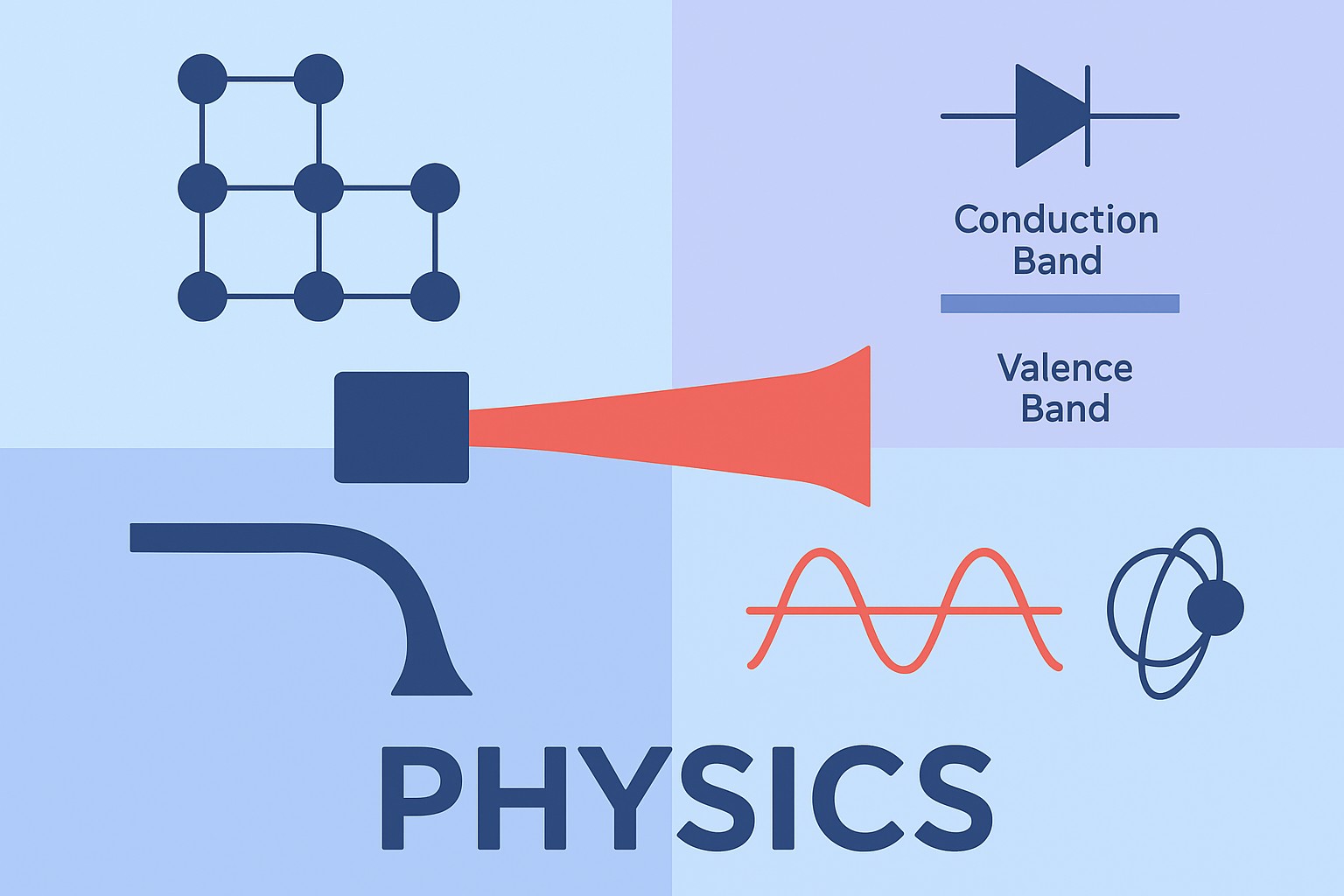
This course introduces engineering students to the fundamental principles of applied physics necessary for understanding materials, devices, and modern technologies. The curriculum covers:
-
Properties of Matter: Elasticity, stress–strain relations, bending of beams, and torsional oscillations.
-
Crystal Physics: Crystal systems, Bravais lattices, Miller indices, packing factors, and crystal growth techniques.
-
Semiconductors & Magnetism: Band theory, p–n junction devices, breakdown mechanisms, and classification of magnetic materials.
-
Quantum Mechanics: Wave–particle duality, Schrödinger’s equation, uncertainty principle, and applications like tunneling and STM.
-
Lasers & Applications: Principles of laser action, diode lasers, quantum cascade lasers, and applications in engineering and medicine.
The associated Physics Laboratory enables hands-on experience in optics, semiconductors, elasticity, fiber optics, and modern physics experiments. Students will gain skills in measurement, data analysis, and application of physical principles to engineering systems.
Learning Outcomes:
By the end of this course, students will be able to:
-
Analyze the elastic properties of solids and determine material constants experimentally.
-
Interpret crystal structures, planes, and defects.
-
Explain semiconductor physics and magnetic materials with device-level applications.
-
Solve fundamental quantum mechanics problems and apply concepts to nanoscale systems.
-
Understand laser principles and evaluate their engineering/medical applications.
- Teacher: Anita Lett J
- Teacher: Murugesan S
Category: ODD
Course Description for SPHB1104 – Physics
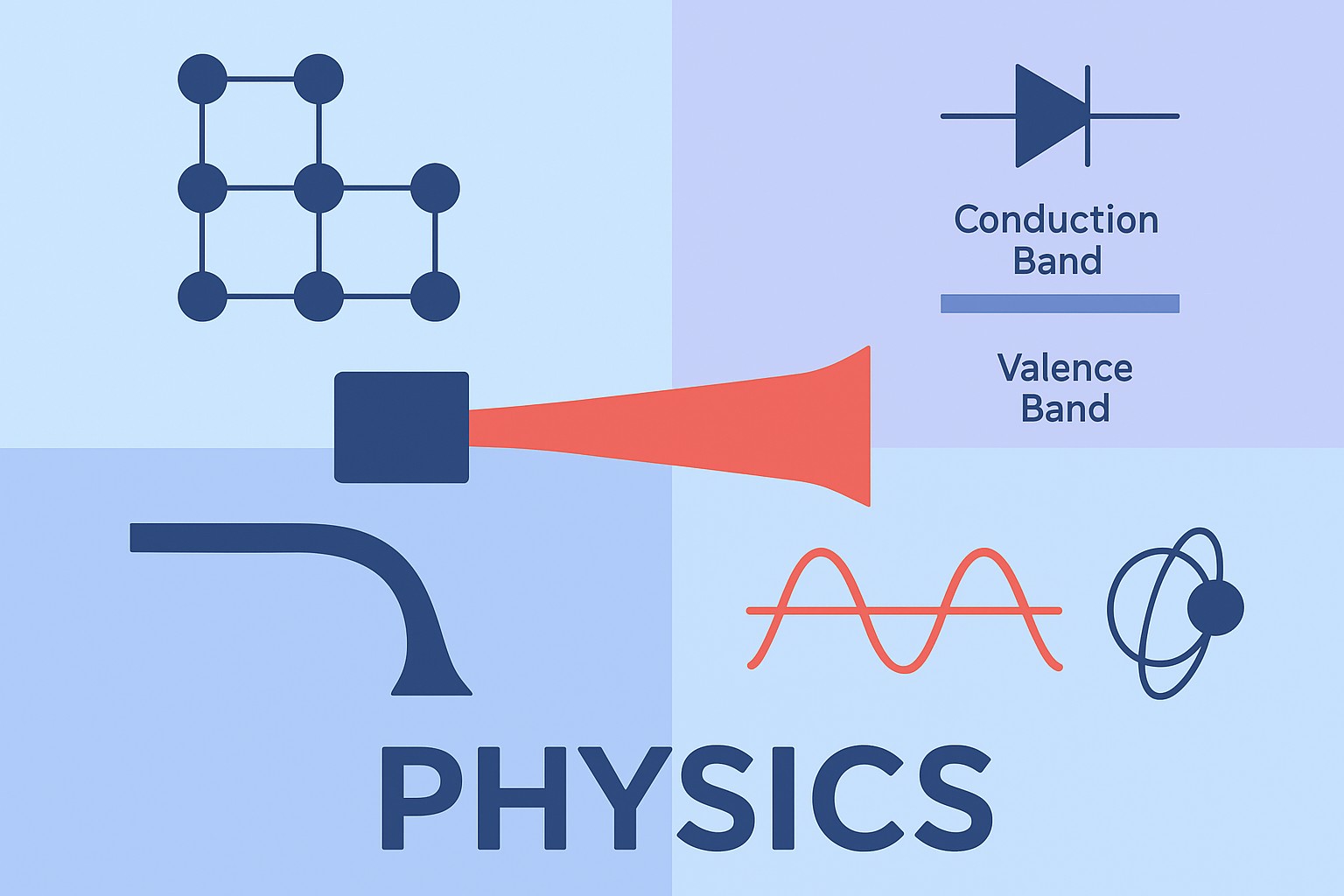
This course introduces engineering students to the fundamental principles of applied physics necessary for understanding materials, devices, and modern technologies. The curriculum covers:
-
Properties of Matter: Elasticity, stress–strain relations, bending of beams, and torsional oscillations.
-
Crystal Physics: Crystal systems, Bravais lattices, Miller indices, packing factors, and crystal growth techniques.
-
Semiconductors & Magnetism: Band theory, p–n junction devices, breakdown mechanisms, and classification of magnetic materials.
-
Quantum Mechanics: Wave–particle duality, Schrödinger’s equation, uncertainty principle, and applications like tunneling and STM.
-
Lasers & Applications: Principles of laser action, diode lasers, quantum cascade lasers, and applications in engineering and medicine.
The associated Physics Laboratory enables hands-on experience in optics, semiconductors, elasticity, fiber optics, and modern physics experiments. Students will gain skills in measurement, data analysis, and application of physical principles to engineering systems.
Learning Outcomes:
By the end of this course, students will be able to:
-
Analyze the elastic properties of solids and determine material constants experimentally.
-
Interpret crystal structures, planes, and defects.
-
Explain semiconductor physics and magnetic materials with device-level applications.
-
Solve fundamental quantum mechanics problems and apply concepts to nanoscale systems.
-
Understand laser principles and evaluate their engineering/medical applications.
- Teacher: Lavanya J
Category: ECE
To understand the basic concepts in static electric field and such as Coulomb’s law and electric potential.
To derive equations for current charges and its applications.
To know about the basic concepts of magnetism and basic laws.
To learn the properties of various circuits are going to be analysed.
To evaluate magnetic concepts and magnetic circuits
To derive equations for current charges and its applications.
To know about the basic concepts of magnetism and basic laws.
To learn the properties of various circuits are going to be analysed.
To evaluate magnetic concepts and magnetic circuits

- Teacher: Jayalakshmi D.S
Category: ODD
The purpose of research is to discover answers to questions through the application of scientific
procedures. The main aim of research is to find out the truth which is hidden and which has not been
discovered as yet. Though each research study has its own specific purpose, we may think of
research objectives as falling into a number of following broad groupings:
1. To gain familiarity with a phenomenon or to achieve new insights into it (studies with this
object in view are termed as exploratory or formulative research studies);
2. To portray accurately the characteristics of a particular individual, situation or a group
(studies with this object in view are known as descriptive research studies);
3. To determine the frequency with which something occurs or with which it is associated
with something else (studies with this object in view are known as diagnostic research
studies);
4. To test a hypothesis of a causal relationship between variables

- Teacher: PARASURAMAN K
Category: ODD
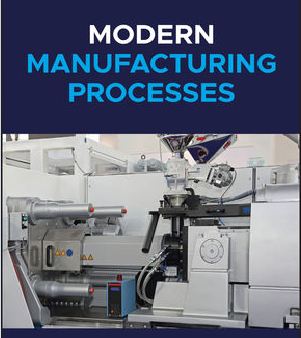
The course is consists of all non-conventional manufacturing processes. It starts with classification of manufacturing processes and necessity of non conventional manufacturing processes. This course dealt with details about the mechanism of material removal, sources of energy used for material removal, working principle, the set up or equipment and relative advantages and disadvantages. It gives a clear cut idea about the processes, its use in specific industrial application etc.
- Teacher: ARUNKUMAR G
Category: EVEN SEMESTER
|
SPYS 1601 |
Core Theory 10 – Counseling and Psychotherapy |
L |
T |
P |
Credits |
Total Marks |
|
4 |
1 |
0 |
4 |
100 |
COURSE OBJECTIVES:
· To get acquainted with nature, process, theories and techniques of counseling, guidance and psychotherapy and its application in therapeutic settings.
· To reflect on rehabilitation aspects.
Unit I–Introduction to Psychotherapy (15 hours)
Main features –Objectives of Psychotherapy – Therapeutic process – Therapist qualities- Effectiveness of Psychotherapy – Ethical issues in research and practice. Evidence-based psychotherapies.
Unit II - Psychodynamic therapies(15 hours)
Traditional psychoanalysis: Freud; free association; psychodynamic therapy: theoretical ground.Therapeutic factors: resistance, transference and counter transference, defense mechanisms. Adlerian therapy; Jungian therapy, Contemporary psychoanalytic therapies.Interpretation of dreams.Indian psyche
Unit III–Cognitive-Behavior therapies(15 hours)
Cognitive therapy: Basic principles, theoretical background, history and development. Cognitive conceptualization. Behavior therapy: Basic principles, theoretical background, history and development. Techniques of classical conditioning,operant conditioning.
Unit IV –Humanistic existential therapies(15 hours)
Humanistic therapy: client- centered therapy; meaning of existence and purpose in life, self-actualization, self-psychology. Existential therapy, logo therapy; Gestalt therapy, Group therapy.Humane approach.Spirituality
Unit V –Other forms of Psychotherapy(15 hours)
Rational Emotive Behavior Therapy: Ellis. Couple therapy, marital and family therapy.Crisis Intervention.Positive Psychological interventions: mindfulness.
- Teacher: Dr.Parveen Banu R
Category: Semester 6
Effective Leadership
Max. Marks:100 ExamDuration:3Hrs.
PARTA: 10 Questions of 2 marks each – No choice 20 Marks
PARTB: 2 Questions from each unit of internal choice; each carrying 16 Marks 80Marks
|
SPYA 1404 |
Open Elective 4 – Effective Leadership |
L |
T |
P |
Credits |
Total Marks |
|
3 |
1 |
0 |
4 |
100 |
UNIT-I
Meaning -Purpose - Leader in Government -Inner Core of leader - Social Response - Essential Behaviours of Good leaders
UNIT-II -
Characterstis of Leader -Types of Leader -Assessment of Leader - Pros and Cons
UNIT-III
Aspiration of Good Leader, Ethics of Leader, Value, Skills
UNIT-IV
Information and Commetments of leader, Communication and Commetments of Leaders
UNIT-V
Sustainabilty of Good Leader - 360 tools - Educating and Developing leader.
References:
1. Svendsen, A., & Laberge, M. (2007). “FOSTERing” collaborative stakeholder relationships. Notes for Practitioners Series: CoreRelation Consulting, Inc. Retrieved from http://masterfulfacilitation.com/ articles/fostering.pdf
2. Tardanico, S. (2013, January 15) 10 Traits of courageous leaders. Forbes: Leadership. Retrieved from https:// www.forbes.com/sites/susantardanico/2013/01/15/10-traits-of-courageous-leaders/#7b075cbb4fc0
3. Th omas, K., & Kilmann, R. (2002). Confl ict mode instrument. USA: Xicom Inc., subsidiary of CPP, Inc. TNS Employee Insights. (2014). 8 Tips to engage your employees. Retrieved from http://tns.tnsemployeeinsights.com/acton/media/2055/employee-engagement-tips-for-managers
- Teacher: Kalaivanan S
Category: EVEN SEMESTER
END SEMESTER EXAMINATION QUESTION PAPER PATTERN
Max. Marks:100 ExamDuration:3Hrs.
PARTA: 10 Questions of 2 marks each – No choice 20 Marks
PARTB: 2 Questions from each unit of internal choice; each carrying 16 Marks 80Marks
|
SPYA 1602 |
Professional Core 10 – Rehabilitation Science |
L |
T |
P |
Credits |
Total Marks |
|
3 |
1 |
0 |
4 |
100 |
UNIT :I (15Hours)
Rehabilitation psychology: overview and concepts- Nature and scope of rehabilitation psychology- Concepts of ability and disability – Recovery - symptom control and rehabilitation - Establishment of division 22 of APA.
UNIT :II (15 Hours)
Importance and applications - Rehabilitation of addictions - drug and alcohol - Rehabilitation after abuse and violence - Palliative care and pain management - role of psychologists.
UNIT: III (15 Hours)
Rehabilitation of persons with physical disabilities – physical - psycho- social and vocational rehabilitation.
UNIT :IV (15 Hours)
Biopsychosocial and social model –Psychodynamic - behavioural approaches to rehabilitation counseling - Cognitive- behavioural approaches to rehabilitation counselling.
UNIT: V (15 Hours )
Parental care and support systems for persons with disabilities - Assessment of persons with disabilities - Legal issues in rehabilitation for persons with disabilities - overview of PWD act - RCI act - national trust act - United Nations convention on the rights of persons with disabilities.
Books for study
1. Chan, F., Berven, N.L., Thomas, K.R. (2004). Counselling Theories and Techniques for Rehabilitation Health Professionals. New York, NY: Springer Publishing Company
2. Falvo, D.R. (2013). Medical and psychosocial aspects of Chronic Illness and disability (5th ed.). Burlington, MA: Jones and Bartlett Learning
3. Frank, G.R., Rosenthal, M., Caplan, B. (2010). Handbook of Rehabilitation Psychology. American Psychological Association.
7. Chan, F., Berven, N.L., Thomas, K.R. (2004). Counselling Theories and Techniques for Rehabilitation Health Professionals. New York, NY: Springer Publishing Company.
Books for reference
1. Federici, S. Scherer M.J. (2012). Assistive Technology Assessment Handbook (Eds.). Boca Raton, FL :Taylor and Francis Group.
2. Riggar, T.F. & Maki, D.R. (2004). Handbook of Rehabilitation Counselling (Eds). New York, NY: Springer Publishing Company.
3. Stuss, D.T., Winokur, G. & Robertson, I.H. (2008).Cognitive neurorehabilitation. UK: Cambridge University Press.
- Teacher: SATHISH KUMAR S
Category: Semester 6
SPYS 1601 | Core Theory 10 – Counseling and Psychotherapy | L | T | P | Credits | Total Marks |
4 | 1 | 0 | 4 | 100 |
COURSE OBJECTIVES:
· To get acquainted with the nature, process, theories and techniques of counseling, guidance and psychotherapy and its application in therapeutic settings.
· To reflect on rehabilitation aspects.
Unit I–Introduction to Psychotherapy (15 hours)
Main features –Objectives of Psychotherapy – Therapeutic process – Therapist qualities- Effectiveness of Psychotherapy – Ethical issues in research and practice. Evidence-based psychotherapies.
Unit II - Psychodynamic therapies(15 hours)
Traditional psychoanalysis: Freud; free association; psychodynamic therapy: theoretical ground.Therapeutic factors: resistance, transference and counter transference, defense mechanisms.Adlerian therapy; Jungian therapy, Contemporary psychoanalytic therapies.Interpretation of dreams.Indian psyche
Unit III–Cognitive-Behavior therapies(15 hours)
Cognitive therapy: Basic principles, theoretical background, history and development. Cognitive conceptualization. Behavior therapy: Basic principles, theoretical background, history and development. Techniques of classical conditioning,operant conditioning.
Unit IV –Humanistic existential therapies(15 hours)
Humanistic therapy: client- centered therapy; meaning of existence and purpose in life, self-actualization, self-psychology. Existential therapy, logo therapy; Gestalt therapy, Group therapy.Humane approach.Spirituality
Unit V –Other forms of Psychotherapy(15 hours)
Rational Emotive Behavior Therapy: Ellis. Couple therapy, marital and family therapy.Crisis Intervention.Positive Psychological interventions: mindfulness.
COURSE OUTCOMES:
1. Remember professional standards of therapeutic counselling practice.
2. Understand the theory and practice of a relational approach to counselling.
3. Evaluate and integrate a range of theoretical approaches into a coherent model of practice.
4. Apply the knowledge, skills and understanding of the reflective practitioner.
5. Create an environment to work competently with diversity and with an anti-oppressive practice.
6. Analyse participation in and potential contribution to the changing (local and global) social, professional and organisational context for therapy.
References:
1.Hersen, M. & Sledge, W. (2002). Encyclopedia of psychotherapy.Academic Press.
2.Yalom, I. (2009). The Gift of Therapy. Harper Perennial: New York.
3.Gobbard, G. Beck, J. Holmes, J. (2007). Oxford Textbook of Psychotherapy. OUP: London.
4.Gerring, R.J. & Zimbardo, P.G. (2006). Psychology and Life. Pearson.
- Teacher: KINJARI K
Category: Semester 6
Unit I: Motivation (15 hours)
Motivation – Meaning - Approaches-Instinct - Drive reduction - Arousal – Incentive -, Cognitive - Humanistic- Maslow’s Need hierarchy – Types-Physiological Motivation [Hunger, Thirst, Sex, Maternal drive] - Psychological motivation [Achievement, Affiliation, Power, Parenting.
Unit II: Intelligence and Assessments(15 Hours)
Concepts and nature of Individual differences – Intelligence - Theories of intelligence- factor and cognitive theories - Characteristics of Intelligence tests - Types of Intelligence tests - Determinants of Intelligence.
Unit III: Emotion (15 Hours)
Emotion - Meaning - Physiological basis of emotions – Theories-James Lange Theory - Cannon Bard Theory - Cognitive Theory.
Unit IV : Personality (15 Hours)
Definition - Approaches – Psychodynamic – Humanistic - Social – Cognitive approach - Assessment of Personality – Questionnaire - Rating Scales and Projective tests – Characteristics - Advantages and disadvantages.
Unit V: Altered States of Consciousness (15 Hours)
Consciousness – Nature – Waking - Sleep and Daydreaming - Biological Rhythms – Circadian - Stages - Dreams-Content, Links between dreams and waking .
COURSE OUTCOMES:
1. To understand the concepts of basic psychological processes, systems and methods underlying human behaviour.
2. To evaluate the various theories in Psychology.
3. To apply the principles of psychology in day-to-day life for a better understanding of the self and others, particularly pertaining to the Indian context.
4. To remember the dynamics of the important cognitive processes.
5. To create and evaluate interventions and strategies and enhance the basic as well as higher-order cognitive functions.
6. Students will be able to identify the major fields of study and theoretical perspectives within psychology and analyse their similarities and differences.
References:
1.Morgan,C.T, King,R.A., Weisz,J.R., and Schopler,J. (2004). Introduction to Psychology, 7th
edition,24th reprint.NewDelhi:TataMcGraw-Hill.
2. Baron, R.A. (1996). Psychology. 3ed. New Delhi: Prentice Hall.
3. Lahey, B. B. (1998). Psychology: An Introduction. New Delhi: Tata Mc Graw Hill.
4. Feldman, R. S. (2002). Understanding Psychology. New Delhi: Tata Mc Graw Hill.
5. Bootzin, R. R., Bower, G. H., Crocker, J., & Hall, E. (1991). Psychology Today. London: Mc Graw Hill.
- Teacher: Kalaivanan S
- Teacher: SUBIKKSHA S
Category: ODD
SPYA1302 - Life Span Development
COURSE OBJECTIVES:
· To explore the various influences on child and adolescent development processes.
· To explore the psychology of exceptional children.
· To explore the various influences on development processes concerning adulthood and aging, taking into consideration the individual, familial and societal contexts.
Unit I : INTRODUCTION (15 hours)
Developmental Psychology - Conception, Pregnancy,And Birth - Stages of Pregnancy –Conception –Implantation -The first trimester -The second trimester - The third trimester - Prenatal Care - Drug use during pregnancy - -Stages of Childbirth - The postpartum stage of childbirth
Unit II : INFANCY AND EARLY CHILDHOOD(15 hours)
Physical and cognitive development- Reflexes and motor skills -Sensation and perception- Psychosocial development – Family Relationships -Attachment – Parenting -Sexuality in Infancy and Toddlerhood - Gender Development - Gender identity -Psychological and social influences on gender identity - Gender roles early childhood: physical and Cognitive development –psychosocial development.
Unit III : MIDDLE CHILDHOOD and ADOLESCENCE(15 hours)
Physical And Congnitive Development –Physical Development in Middle Childhood and Adolescence- Physical changes - Brain and nervous system development - Motor skills – Health - Cognitive Development in Middle Childhood and Adolescence - Self-Concept - Social Cognition - Family Relationships - Peer Pressure - Sexuality in Middle Childhood
Unit IV : Early Adulthood and Middle Adulthood(15 hours)
Physical And Cognitive Development - Physical Development In Early Adulthood And Middle Adulthood – Health in Adulthood - Intellectual Development in Adulthood - Independence In Early Adulthood - Establishing A Career - Psychosocial Development - Crisis -Relationships In Middle Adulthood
Unit V :LATE ADULTHOOD (15 hours)
Physical Development in Late Adulthood - Health in Late Adulthood - Dementia and Alzheimer’s disease - Intelligence and Memory - Relationships - Late adulthood and sexuality - Relationships with adult children - Elderly abuse - Relationships with grandchildren .
COURSE OUTCOMES:
1. Understand theory and research in physical, cognitive, communication, emotional, and social development of the Child , Adolescence and adult.
2. Understand the physical, cognitive, communication, emotional, and social development of the infant and child..
3. Apply knowledge of infant and child development to facilitate and understanding of developmental outcomes.
References:
1.Papilla, Diane E, Olds, Sally Wendoks(1992): Human Development, Tata McGraw Hill Publishing Co
2.Shaffer, David R. (1996): Developmental Psychology, IV Edition, Brooks/Cole Publishing Company.
3.Hurlock, E.: Developmental Psychology (1980), Tata McGraw Hill Publishing Co.
- Teacher: SATHISH KUMAR S
Category: ODD
Unit I: Introduction to Statistics (15 hours)
Introduction to Statistics: the meaning of statistics - Need and importance of statistics in psychology - Prerequisites for studying statistics- Descriptive and inferential statistics - Frequency Distribution and Graphic representation of data: Histogram - Bar diagram - Pie Chart - Scatter Plot.
Unit II: Measures of Central Tendency and Variability (15 hours)
Computation of Mean, Median and Mode and their uses. Measures of variability: Computation of quartile and standard deviations - Cumulative distribution - Percentiles standard scores and their uses. Normal distribution curve: Characteristics and application - Kurtosis and Skewness.
Unit III: Parametric tests (15 hours)
Correlations: Meaning and methods – Characteristics - Pearson’s Product Moment Correlation - Point-Biserial Correlation and Phi - Biserial and Tetrachoric Correlation - Tests of Significance: t- test - Analysis of Variance (ANOVA): One way and Two way Analysis of Variance,
Unit IV: Non-parametric tests (15 hours)
Spearman’s Rank Correlation –Regression: Simple linear regression – Multiple Regression - Chi Square Test - Wilcoxon signed rank test - Mann- Whitney U test - Kruskal-Wallis (KW) test - Friedman's test
Unit V: Test construction and standardization (15 hours)
Characteristics of a good test - Steps in test construction: Item-analysis - determination of item difficulty - item discrimination - problems of item analysis - Introduction to SPSS: Meaning- Uses of SPSS in Statistics and Research.
- Teacher: KRISHNAPRIYA B
Category: Semester 4
|
SPYB4001 |
Personality Development |
L |
T |
P |
EL |
Credits |
Total Marks |
|
3 |
1 |
0 |
0 |
4 |
100 |
COURSE OBJECTIVES:
To enable the students to
· Understand the meaning and nature of personality
· Analyze their attitudes for personal enrichment
· Understand the concept of motivation and achievement motivation
· Maintain healthy relationships with others in turn developing personalities
UNIT – I: Meaning and Nature of Personality 15 Hours
Personality: Definitions, Meanings, Elements of personality, Types of Personality, Determinants of personality, Personality SWOT Analysis.
UNIT – II: Personality Enrichment 15 Hours
Self esteem, Self concept, Advantages of high self esteem, Characteristics of people with high and low self esteem, Steps to building positive self esteem, Attitude, Factors that determine our attitude., Benefits of a positive attitude and consequences of a negative attitude, Steps to building a positive attitude.
UNIT – III: Motivation 15 Hours
Motivation: Meaning and nature, The difference between inspiration and motivation, Motivation redefined, External motivation vs. Internal motivation, Achievement motivation
UNIT – IV: Success 15 Hours
Defining success-Real or imagined obstacles to success, Qualities that make a person successful, Reasons for failure – Interpersonal skills, Dealing with seniors, colleagues, juniors, customers, suppliers at the workplace.
UNIT – V: Positive Relationships & Personality 15 Hours
Positive Relationships – Factors that prevent building and maintaining positive relationships, the difference between ego and pride, the difference between selfishness and self interest, Steps for building a positive personality, Body language: understanding body language, Projecting positive body language.
COURSE OUTCOMES
1. To understand different elements of personality
2. They can able to know different types of Personality
3. Students can understand determinants of personality
4. To understand advantages of high self esteem
5. Students will be able to acquire the skills to manage time and relationship
6. Students can identify the factors that prevent building and maintaining positive relationships
TEXT / REFERENCE BOOKS
- Nathan Dorman (2004) Personality Development Abishek Publication, New Delhi.
- Jafar Mahmud (2004) Introduction to Psychology APH Publishing Corporation, New Delhi.
- Zig Ziglar (2000) See You at the Top Magna Publishing Co. Ltd., Mumbai.
- Shiv Khera (1998) You can win MacMillan India Ltd., New Delhi.
- Walter Doyle Staples (2000) Think Like a Winner Magna Publishing co. Ltd., Mumbai\
END SEMESTER EXAMINATION QUESTION PAPER PATTERN
Max. Marks: 100 Exam Duration: 3Hrs.
PART - A: 10 Questions of 2 marks each – No choice 20 Marks
PART - B: 2 Questions from each UNIT of internal choice; each carrying 16 Marks 80 Marks
- Teacher: SUBIKKSHA S
Category: ODD
|
SPYA1604 |
Professional Elective II – Stress Management
|
L |
T |
P |
Credits |
Total Marks |
|
3 |
1 |
|
4 |
100 |
Objectives
1. To understand how the stressors will change the Life events or life change events.
2. To know the different Theories of Stress.
3. To highlight the different types of relaxation technique to reduce stress.
Unit-I (15 hours)
Introduction: The science and sources of stress – Stress and health – Types of stress –concept of stress – Causes of stress –Theories of stress - Response-based concept of stress - Event-based concept of stress
Unit –II (15 hours)
Stressors -Life events or life change events -Chronic stressors -Effects of stress on the body -Enhancing awareness about managing stress - The health belief model and its application to stress management: an in -depth investigation.
Unit – III (15 hours)
Relaxation: Meaning – Sleep – Sleep related disorders - Relaxation techniques: yoga and meditation –Biofeedback -Progressive muscle relaxation - Autogenic training -Visual imagery - Self-hypnosis - Humor, stress, and relaxation - Mindfulness meditation.
Unit IV (15 hours)
Coping mechanisms: Method Based on Rational Emotive Therapy-Method Based on Simplified Kundalini Yoga -Method Based on Gestalt Therapy - Systematic Desensitization - Cognitive Behavioral Therapy -Regular physical activity and exercise.
Unit –V (15 hours)
Implementing a Stress Reduction Plan: Importance of implementing a plan - Stages of change - Determining goals, objectives, and targets: goal setting: Establishing objectives - Deciding targets -Social support.
- Teacher: Kalaivanan S
Category: Semester 4
M.Sc (Mathematics)
Category: School of Science and Humanities
|
SMEB1303 |
STRENGTH OF MATERIALS |
L |
T |
P |
Credits |
Max.Marks 100 |
|
3 |
* |
0 |
3 |
OBJECTIVE:
- To study the aspects of Strength, Stiffness and Stability.
- To gain knowledge of different types of stresses, strain and deformation induced in the components due to external loads.
- To study the distribution of various stresses in the elements such as beams, shafts etc.
- To study the effect of component dimensions and shapes on the stresses and deformations.
UNIT 1: STRESS STRAIN DEFORMATION OF SOLIDS 9 Hrs
Rigid and Deformable bodies – Strength, Stiffness and Stability – Stresses; Tensile, Compressive and Shear –Deformation of simple and compound bars under axial load – Thermal stresses and strains. Elastic constants – Relation between Elastic constants - Strain energy and unit strain energy – Strain energy in uniaxial loads.
UNIT 2: ANALYSIS OF STRESSES IN TWO DIMENSIONS 9 Hrs
Principal planes and stresses – Mohr’s circle for biaxial stresses – Maximum shear stress - simple problems- Stresses on inclined plane. Biaxial state of stresses – Thin cylindrical and spherical shells – Deformation in thin cylindrical and spherical shells – Efficiency of joint- Effect of Internal Pressure.
UNIT 3: BEAMS - LOADS AND STRESSES 9 Hrs
Types of beams - Supports and Loads – Shear force and Bending Moment in beams – Cantilever, Simply supported andOverhanging beams – SFD and BMD for inclined loads and couples.Stresses in beams – Theory of simple bending – Stress variation along the length and in the beam section – Effect of shape of beam section on stress induced.
UNIT 4: TORSION 9 Hrs
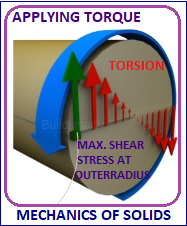
Analysis of torsion of circular bars – Shear stress distribution – Bars of Solid and hollow circular section – Stepped shaft – Twist and torsion stiffness – Composite shafts Springs - Laminated springs, axial load and twisting moment acting simultaneously both for open and closed coiled springs– Deflection of helical coil springs under axial loads – stresses in helical coil springs under torsion.
UNIT 5: BEAM DEFLECTION 9 Hrs
Columns – End conditions – Equivalent length of a column – Euler equation – Slenderness ratio – Rankine Gordon formula for columns.Elastic curve of Neutral axis of the beam under normal loads – Evaluation of beam deflection and slope: Double integration method, Macaulay Method, and Moment-area Method.
Max.45Hours
COURSE OUTCOMES:
On completion of the course, student will be able to
CO1: Understand the fundamentals of Stress and Elastic Constants.
CO2: Understand the concept of Principal stresses and thin shells.
CO3: Construct Shear force & Bending moment diagram and Bending stress.
CO4: Apply the Concept of Torsion for Circular Shafts and Understand the concept of Springs.
CO5: Understand the theory of Column and Beam deflection.
CO6: Analyze overall deflection aspects related to Strength, Stiffness and Stability.
TEXT / REFERENCE BOOKS
1. Bansal R.K., “Strength of Materials”, Laxmi Publications (P) Ltd.,Fifth Edition,2012
2. Punmia B.C. & Jain A.K., Mechanics of Materials, ,Laxmi Publications,2001
3. Ryder G.H, “Strength of Materials, Macmillan India Ltd”., Third Edition, 2002
4. Ray Hulse, Keith Sherwin & Jack Cain, “Solid Mechanics”, Palgrave ANE Books,2004.
5. Allan F. Bower, Applied Mechanics of Solids, CRC Press, 2009, 820 pages.
END SEMESTER EXAMINATION QUESTION PAPER PATTERN
Max. Marks : 100 Exam Duration : 3 Hrs.
PART A : 2 Questions from each unit, each carrying 2 marks 20 Marks
PART B : 2 Questions from each unit with internal choice, each carrying 16 marks 80 Marks
- Teacher: HEMANANDH J
- Teacher: LAKSHMI SANKAR S
Category: ODD SEMESTER
COURSE OBJECTIVE
To help students learn and analyze the various content in media so that they are aware of the content produced in media.
To understand how media constructs reality and to choose right tool to analyze content provided in print and electronic medium.
UNIT 1 MEDIA CONTENT
Media Content - Media text as arrangements of signs – Narrative, genre - discourse analysis –Text, intertextuality & context - institutions & ways of seeing discourse analysis – sources - technologies of the gallery & museum
UNIT 2 MARXISM & IDEOLOGY
Media as Manipulators: Marxism & Ideology – culture industry as mass deception – ideological meanings –arguments and criticisms – communication flows & consumer resistance, Media & public sphere - nation as imagined community - digital dilution of nation
UNIT 3 PSYCHOANALYSIS
Psychoanalysis: visual culture, visual pleasure & visual disruption – subjectivity, sexuality & conscious Audience studies : audience, fans, users , ethnographies of visual objects
UNIT 4 COMPOSITIONAL INTERPRETATION
Critical study of visual methodology –production –image – compositional interpretation: technology & image production – media ,gender & sexuality : construction of femininity , patriarchal romance & domesticity – empowering – media & masculinities.
UNIT 5 SEMIOLOGY
From quality to quantity: content analysis : introduction - four steps to content analysis – semiological study – selecting images for study - sign making meaning processes – social semiotics

- Teacher: Dr. A R VIMAL RAJ
Category: EVEN SEMESTER
The Visual Narrative Method course provides a comprehensive introduction to the theories and concepts that shape storytelling through visual media. Students will begin by exploring visual semiotics, which involves understanding how signs, symbols, and images create meaning. The course then delves into the basic elements of narrative structure, such as plot, character, and setting, and how these are expressed visually. Key topics include the principles of composition, the use of perspective, and the way time and motion are depicted in visual storytelling.In addition, the course examines how different cultures and societies interpret visual narratives, highlighting the impact of cultural context on audience perception. Ethical considerations are also addressed, particularly in terms of how people, cultures, and events are represented in visual media. By studying a variety of genres and engaging with real-world examples, students will learn how visual narratives can both reflect and influence societal values and ideologies.Throughout the course, students will engage in critical analysis of visual narratives, applying theoretical frameworks to deepen their understanding. The course culminates in a final project where students will choose a visual narrative to analyze in detail, allowing them to apply their knowledge and develop strong analytical skills. This course is designed to prepare students for advanced studies or careers in fields like media studies, film theory, and visual communication.
- Teacher: Prasanna Lakshmi S
Category: ODD