
Search results: 1467
COURSE OBJECTIVES
To introduce the concepts of mass, momentum and energy conservation relating to aerodynamics.
To make the student understand the concept of vorticity, irotationality, theory of airfoils and wing sections.
To introduce the basics of viscous flow.
UNIT 1 REVIEW OF BASIC AERODYNAMICS 9 Hrs.
Atmosphere- Air speeds- Aerodynamic definitions Types of Drag- General Aerodynamic characteristics of airfoil sections-Complex potential-Singularities-Equations of Vortex-doublet and Rankine oval - Lift and Drag on cylinder and Aero foil.
UNIT 2 LOW SPEED FLOW 9 Hrs.
Models of the fluid: control volumes and fluid elements. Continuity, Momentum and energy equations. Substantial derivative, incompressible Bernoulli’s equation.
UNIT 3 AIRFOIL AND CONFORMAL TRANSFORMATION 9 Hrs.
Airfoils Nomenclature and NACA series, Airfoil Characteristics, Vortex sheet, Kelvin Circulation theorem Thin aerofoil theory and its applications. Joukowski transformation and its application to fluid flow problems.
UNIT 4 WING THEORY 9 Hrs.
Introduction to Finite wing, Downwash and Induced Drag, Biot -Savart law and Helmhotz’s theorems, Horse shoe vortex, Prandtl’s Classical Lifting line theory and its limitations.
UNIT 5 VISCOUS FLOW 9 Hrs.
Derivation of Navier-Stokes equation for two-dimensional flows, boundary layer approximations, laminar boundary equations and boundary conditions, Blasius solution, qualitative features of boundary layer flow under pressure gradients, Integral method, aspects of transition to turbulence, turbulent boundary layer properties over a flat plate at low speeds. Separation of flow over bodies stream lined and bluff bodies, Lift and Drag on cylinder and Aero foil.
COURSE OUTCOMES
On completion of the course, student will be able to
CO1 - Apply aerodynamics concepts.
CO2 - Develops mathematical modelling ability.
CO3 - Differentiate between ideal and real flows.
CO4 - Model flow over wing.
CO5 - Understand the real time viscous flow.
CO6 - Understand the Boundary Layer behaviour.
TEXT / REFERENCE BOOKS
1. Aerodynamics for. Engineering Students. Sixth Edition. E.L. Houghton. P.W. Carpenter. Steven H. Collicott. Daniel T. Valentine, 2013 Elsevier, Ltd.
2. Bertin, John J., Aerodynamics for Engineers, Pearson Education Inc., 2002.
3. John J. Bertin, Russell M. Cummings, “Aerodynamics for Engineering students”, Sixth Edition,Pearson,2013.
4. Anderson J.D., “Fundamentals of Aerodynamics”, Sixth Edition , McGraw Hill Book Co., NewYork,2017.
5. Schlichting H., “Boundary layer theory” , Seventh Edition, McGraw Hill, NewYork 2014.
- Teacher: Madhan Kumar G
- Teacher: MATHIYARASI M
Category: EVEN SEMESTER
COURSE OBJECTIVES
To introduce the concepts of compressibility.
To make the student understand the theory behind the formation of shocks and expansion fans in Supersonic flows.
To introduce the methodology of measurements in Supersonic flows.
UNIT 1 CONCEPTS OF COMPRESSIBLE FLOW 9 Hrs.
Basic concepts of compressible flow, Review of continuity, energy and momentum equations. One dimensional inviscid flow; Stagnation quantities; Isentropic conditions. Speed of sound and Mach number; Isentropic relations; Area-velocity relation. Flow through constant area duct.
UNIT 2 COMPRESSION AND EXPANSION WAVES 9 Hrs.
Normal shock –Prandtl equation and Rankine–Hugonoit relation .Oblique shock and supersonic compression by turning. Weak shocks and Mach waves; Super sonic expansion by turning. Prandtl-Meyer expansion fan; Reflection and intersection of shocks. Shock detachment and bow shock; Shock Expansion theory with application to thin airfoils.
UNIT 3 AIRFOIL IN HIGH SPEED FLOWS 9 Hrs.
Small perturbation potential theory, solutions for supersonic flows, Mach waves and Mach angles, Prandtl-Glauert rule - affine transformation relations for subsonic flows, linearized two dimensional supersonic flow theory - Lift, drag, pitching moment and center of pressure of supersonic profiles.
UNIT 4 TRANSONIC FLOW OVER WING 9 Hrs.
Lower and upper critical mach numbers, Lift and drag divergence, shock induced separation, characteristics of swept wings, Effects of thickness, camber and aspect ratio of wings, Transonic area rule, Tip effects.
UNIT 5 EXPERIMENTAL TECHNIQUES FOR HIGH SPEED FLOWS 9 Hrs.
Blow down, indraft and induction tunnel layouts and their design features. Transonic, supersonic and hypersonic tunnels and their peculiarities. Helium and gun tunnels, Shock tubes, Optical methods of flow visualization.
Max.45 Hrs.
COURSE OUTCOMES
On completion of the course, student will be able to
CO1 - Acquire knowledge on the basic concepts of compressible flowCO2 - Distinguish the compression and expansion waves on arbitrary bodies and open deflected conduits. CO3 - Solve the lift, drag and center of pressure of supersonic airfoils.
CO4 - Differentiate the transonic flow effects over Wings and wing fuselage compartment.
CO5 - Understand the different types of tunnel layouts and their design features.
CO6 - Analyse the shock tube effect and application of flow visualization in it.
TEXT / REFERENCE BOOKS
1. Radhakrishnan, Ethirajan., Gas Dynamics, John Wiley & Sons,2010.
2. Anderson J. D., Jr., Modern Compressible Flow with Historical Perspective, McGraw Hill Publishing Co.,2004.
3. H W Liepmann and A Roshko, Elements of Gas Dynamics, John Wiley & Sons.
4. Shapiro, A.H., "Dynamics and Thermodynamics of Compressible Fluid Flow", Ronold Press.
5. Zucrow, M.J. and Anderson, J.D., "Elements of gas dynamics", McGraw-Hill Book Co., New York.
6. Clancy,L,J., “Aerodynamics”, Pitman, Shroff Publishing co.,2006.
- Teacher: Madhan Kumar G
Category: ODD SEMESTER
|
SAEB2301 |
SIMULATION LAB |
L |
T |
P |
EL |
Credits |
Total Marks |
|
0 |
0 |
4 |
0 |
2 |
100 |
||
|
COURSE OBJECTIVES Ø To make students learn the steps involved in quadcopter simulation. Ø To introduce the knowledge about fidelity models. Ø To impart practical knowledge to students on determining the visualization techniques. Ø To find the waypoint follower and orbit follower in drones. Ø To impart practical knowledge to students about different simulators of drone and flight
|
|||||||
|
LIST OF EXPERIMENTS |
|||||||
|
1. Quadcopter 3D Simulation 2. Fixed Wing Low Fidelity Model 3. Multi Rotor Low Fidelity Model 4. Depth and Semantic Segmentation Visualization 5. Waypoint follower, Orbit follower 6. Packet delivery 7. Drone Simulation pattern Square, circle clockwise and Anti-clock wise 8. Drone Simulation pattern spiral takeoff and Landing, Shape Eight 9. Aircraft simulation Take off 10. Aircraft simulation Landing
|
|||||||
|
Max. 45 Hrs. COURSE OUTCOMES On completion of the course, student will be able to CO1 - Acquire simulation experience of a Quadcopter. CO2 - Impart the knowledge on Fidelity models for fixed wing and multi rotor. CO3 - Visualize the depth and semantic segmentation of the drones. CO4 - Compute the waypoint follower and orbit follower for drones CO5 - Get practical experience on flying of various drones CO6 - Get practical experience on flying of Aircrafts
|
|||||||
- Teacher: Madhan Kumar G
Category: ODD SEMESTER
COURSE OBJECTIVE
- To study the various types of communication techniques and their analysis based on Fourier transform and to provide fundamental knowledge of pulse modulation techniques and their types.
UNIT 1 SIGNAL ANALYSIS
Fourier transform of gate functions, delta functions at the origin – Two delta function and periodic delta function – properties of Fourier transform – Frequency shifting – Time shifting – Convolution theorem – Frequency convolution theorem – Sampling theorem.
UNIT 2 PULSE MODULATION AND COMMUNICATION
Pulse amplitude modulation – Natural sampling -Instantaneous sampling Transmission of PAM signals – Pulse width modulation – Time division multiplexing and frequency division multiplexing – Band width requirements for PAM signals – Pulse code modulation – Principles of PCU – Quantizing noise – Generation and demodulation of PCM – Effects of noise – Advantages and application of PCM – Differential PCM (DPCM) – Delta modulation.
UNIT 3 BROAD BAND COMMUNICATION
Coaxial cable circuit -Parallel wire line circuit – Computer communication – Digital data communication – Modems – Microwave communication links – LOS links – Tropospheric scatter microwave links – Integrated Service Digital Network (ISDN) – Architecture – Broadband ISDN – Local Area Network (LAN) – LAN topologies – Private Branch Exchange (PBX).
UNIT 4 SATELLITE COMMUNICATION
Introduction – Communication satellite systems – Transmitting and receiving earth station – Satellite orbits – Satellite frequency bands – Satellite multiple access formats – FDMA – CDMA – Satellite channel, Power flow – Polarization antenna gain – Parabolic dish antenna – Power loss – Rainfall effect – Receiver noise –satellite system power budget: EIRP, received power Carrier to noise ratio, G/T ratio. – Satellite link analysis – Up link – Down link – Cross link – Direct Home TV broadcasting – Satellite transponders.
UNIT 5 RADAR SYSTEMS AND OPTICAL FIBER
Introduction, Basic Radar systems, Radar systems – Radar range – Pulsed radar system – A Scope – Plan Position Indicator (PPI) – Search Radar – Tracking Radar – Moving Target Indicator (MTI) – Doppler Effect – MTI principle – Digital MTI – Radar Beacons. Optical Fiber: Introduction to light, optical fiber and fiber cables, optical fiber characteristics and classification, losses, Fiber optic components and systems, Installation, testing and repair.
Course Outcomes:
By the end of this course students will be able to
CO1: Design, operation, and troubleshoot of electronic systems
CO2: Solve electronic devices and systems using mathematical concepts.
CO3: Analyze electronics devices and circuits using computer simulations.
CO4: Analyze components associated with digital and analog electronic/communication systems.
CO5: Analyze basic wireless and communication circuits using computer simulations

- Teacher: KEVIN BENNETT S
Category: Semester 4
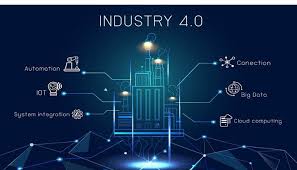
The Fourth Industrial Revolution is the ongoing automation of traditional manufacturing and industrial practices, using modern smart technology.
SAIC4001 Industry 4.0
UNIT 1 ADVANCED TECHNOLOGY AND MATERIALS
Advanced electro-optical sensing technology-active, passive multi-spectral and hyper spectral imaging; electronic beam steering; vacuum technology, surface and coating technology, health care technology, Nanotechnology- Nanomechanics, Nano optoelectronics; energy storage technology-next generation Li-based Batteries, Hydrogen storage, solar photovoltaic’s, Flexible electronics. Intellectual Property Rights - case studies governing/pertaining to Materials/Technology.
UNIT 2 TRANSFORMING TECHNOLOGIES IN BIOENGINEERING
Establishment of smart biotechnology factory, Artificial intelligence in Bioprocess technology, Omics – Big data analysis through automation, 3D bio printing for tissue engineering. Simulation tools, RSM and Box model. Cyber physical system based telemedicine, diagnosis and therapeutics through real time biosensors. Bionanotechnology. Case studies –Intellectual Property rights infringement in Biology.
UNIT 3 ADVANCEMENTS IN SUSTAINABLE BUILT ENVIRONMENT
Introduction – Technological developments in Architectural, Engineering and Construction (AEC) - Building Information Modelling (BIM) using Cloud computing technology and Internet of things (IoT) – Unmanned Aerial Vehicles, sensors – Additive manufacturing in construction – Concrete 3D printing - Materials used - Lightweight and functionally graded structures - Net Zero Energy buildings, Bioswales, Biofiltration pond, Ecosan systems- Recent developments in Waste water Management, Air pollution control, waste disposal, public health issues-improving water management in surface and overhead irrigation- Integration of energy, water and environmental systems for a sustainable development.
UNIT 4 SMART MANUFACTURING
Smart factories and interconnection, Smart Manufacturing – automation systems, Additive Manufacturing, Smart grids, Micro Electro Mechanical Systems (MEMS), Stealth technology, Metal Finishing, Self propelled vehicles, e mobility, Green fuels, drones – unmanned aerial vehicles(UAVs), aerodynamics. Robotic Automation and Collaborative Robots – Augmented reality and haptics, engineering cybernetics and artificial intelligence (AI), Disruptive Technologies – Frugal Innovations – Intellectual Property Rights (IPR): Case Studies.
UNIT 5 SMART WORLD
Smart Sensors and IIOT, Smart grid, Hybrid renewable energy systems, Electronics in Smart city, Integration of Sensors in Robots and Artificial Intelligence, 5G Technology, Communication protocols, Human-Machine Interaction, Virtual Reality, Quantum Computing: Changing trends in transistor technology: Processor, Intellectual Property Rights- Case Studies.
UNIT 6 CYBER PHYSICAL SYSTEMS
Introduction to Cyber Physical Systems (CPS), Architecture of CPS, Data science and technology for CPS, Prototypes of CPS, Emerging applications in CPS including social space, crowd sourcing, healthcare and human computer interactions, Industrial Artificial Intelligence, Networking systems for CPS applications, Wearable cyber physical systems and applications, Domain applications of CPS: Agriculture, Infrastructure, Disaster management, Energy, Transportation, Intellectual Property Rights (IPR) : Case Studies.
TEXT / REFERENCE BOOKS
1. William D. Callister,“Materials Science and Engineering, An Introduction”, John Willey and Sons Inc. Singapore, 2001.
2. V. Raghavan, “Physical Metallurgy: Principle and Practice”, Prentice Hall India Pvt Ltd, 2006.
3. Flavio Craveiro, Jose Pinto Duarte, Helena Bartolo and Paulo Jorge Bartolo, “Additive manufacturing as an enabling
technology for digital construction: A perspective on Construction 4.0”, Automation in Construction, Vol. 103,pp. 251-267, 2019.
3. Klaus Schwab, “Fourth Industrial Revolution”, Random House USA Inc, New York, USA, 2017.
4. Oliver Grunow, ”SMART FACTORY AND INDUSTRY 4.0. The current state of Application Technologies”, Studylab Publications, 2016.
5. Alasdair Gilchrist, “INDUSTRY 4.0: Industrial Internet of Things”, Apress, 2016.
- Teacher: Balamurugan Velan
Category: EVEN SEMESTER
The objectives of this subject are to give the students an understanding of:
➢ Fundamentals of Indian Political System analyzed from varied perspectives
➢ Philosophical basis of Indian Constitution
➢ Working of Indian Constitution as a living document
➢ Theoretical Basis and Practices of Directive Principles of State Policy and Fundamental Rights as available in the Constitution
➢ Institutional Structure and functions of Indian Polity
➢ Social Issues in India and Political Responses to approach them
➢ Political Economy of Indian State
➢ Nature and Purpose of Social Movements in India
- Teacher: Dr.T. AMBIKA
Category: ODD SEMESTER
This course is designed to help students to understand the nature and challenges of Indian welfare state and to acquaint the students to the changing dimensions and perspectives on working with vulnerable sections of society. It will equip the students for a career in social sector like NGOs, Corporate Social Responsibility and Government welfare agencies.

- Teacher: Dr. N. SOFIA
Category: ODD SEMESTER

The primary emphasis of the present work is to synthesis all major provisions of the Constitutional law which come across with every Indian from day to day life and which are the very basic provisions of the Constitutional Law including but not limited to the purpose of Constitutional Law, formation of Constitutional Law, key provisions, Preamble, Union of India, Citizenship, Fundamental Entitlements, Directive Principles of the State Policy, Fundamental Duties, President of India, Prime Minister, Attorney General of India, Parliament of India, Powers of House of the People and Council of States, Parliamentary Committees, Sessions of Parliament, Comptroller and Auditors General of India, Supreme Court of India and High Court jurisdiction, Pertains between the Union and the States, Entitlement to property Elections, Emergency provisions.
Category: EVEN SEMESTER
The primary emphasis of the present work is to synthesis all major provisions of the Constitutional law which come across with every Indian from day to day life and which are the very basic provisions of the Constitutional Law including but not limited to the purpose of Constitutional Law, formation of Constitutional Law, key provisions, Preamble, Union of India, Citizenship, Fundamental Entitlements, Directive Principles of the State Policy, Fundamental Duties, President of India, Prime Minister, Attorney General of India, Parliament of India, Powers of House of the People and Council of States, Parliamentary Committees, Sessions of Parliament, Comptroller and Auditors General of India, Supreme Court of India and High Court jurisdiction, Pertains between the Union and the States, Entitlement to property Elections, Emergency provisions.
Category: EVEN SEMESTER
- Teacher: Yuva Poornima A
- Teacher: Yazhini Kuppusamy
- Teacher: Manas Unnikrishnan
Category: EVEN SEMESTER
- Teacher: Anjana Lakshmi .
- Teacher: Madhana B
- Teacher: Dhanushyadevi S
Category: ODD SEMESTER
OBJECTIVES
to understand the concept and classification of property as well as principles governing transfer of immovable property and easements.
-
To study about the concept of ‘Property’, the ‘nature of property rights’ and the general principles governing the transfer of property.
-
To gain knowledge about the substantive law relating to particular transfers, such as sale, mortgage, lease, exchange, gift and actionable claims
- Teacher: Anjana Lakshmi .
- Teacher: Monisha S
Category: ODD SEMESTER
Information Technology Laws:
- To understand Cyber Space and Information Technology Act, 2000
- To learn multifarious changes brought in to substantive and Procedural changes
- To know various facets of Cyber Laws and its impact on the modern world
- Teacher: KAVIYA R
- Teacher: S B Reshma John
Category: ODD SEMESTER
The course provides an introduction to basic human rights philosophy, principles,
instruments and institutions, and also an overview of current issues and debates in the field
with focus on the problems specific to Bulgaria.
This course aims to explore some aspects of the diverse and increasingly complex body of
international law of human rights that has both national and international application. The
course also seeks to analyze the ways in which allegations of human rights violations are
dealt with in the Bulgarian courts and the impact of human rights discourse on international
politics and relations.

- Teacher: Anjana Lakshmi .
- Teacher: Vinaya G
Category: ODD SEMESTER
Labour law also known as employment law is the body of laws, administrative rulings, and precedents which address the legal rights of, and restrictions on, working people and their organisations. As such, it mediates many aspects of the relationship between trade unions, employers and employees. In other words, Labour law defines the rights and obligations as workers, union members and employers in the workplace.
- Teacher: Vinaya G
- Teacher: MOHANAPRIYA M
Category: 2024 - 20025 - Even Semester
- Teacher: Vinaya G
Category: 2024 - 20025 - Even Semester
Labour law also known as employment law is the body of laws, administrative rulings, and precedents which address the legal rights of, and restrictions on, working people and their organisations. As such, it mediates many aspects of the relationship between trade unions, employers and employees. In other words, Labour law defines the rights and obligations as workers, union members and employers in the workplace.
- Teacher: Madhana B
- Teacher: Dhanushyadevi S
Category: EVEN SEMESTER
Labour law also known as employment law is the body of laws, administrative rulings, and
precedents which address the legal rights of, and restrictions on, working people and their
organisations. As such, it mediates many aspects of the relationship between trade unions,
employers and employees. In other words, Labour law defines the rights and obligations as workers,
union members and employers in the workplace.
- Teacher: Madhana B
Category: EVEN SEMESTER