
Search results: 1467
- Teacher: Jayshree Nellore
Category: ODD SEMESTER
- Teacher: Prakash P
Category: ODD SEMESTER
Food processing Technology- explaining the food processing technique by industrial-level methodologies are explained
- Teacher: Usha Nandhini S
Category: Semester 4
- Teacher: Prakash P
Category: ODD SEMESTER
Biochemical Engineering is a branch of chemical engineering that mainly deals with the design and construction of unit processes operations make use of microbial, animal and plant cells and components of cells such as enzymes to manufacture new products and destroy harmful wastes.
- Teacher: Prabu Deivasigamani
- Teacher: Inbathamizh L
- Teacher: Thyagarajan Rajendiran
Category: EVEN SEMESTER
This subject deals with the basic introduction of chemical industries and equipment used in them. This subject also explains the process involved in separating products from raw materials.
- Teacher: Venkatesan D
- Teacher: Karthikeyan M
- Teacher: Michael Rahul Soosai
Category: ODD
BASICS
OF MATLAB
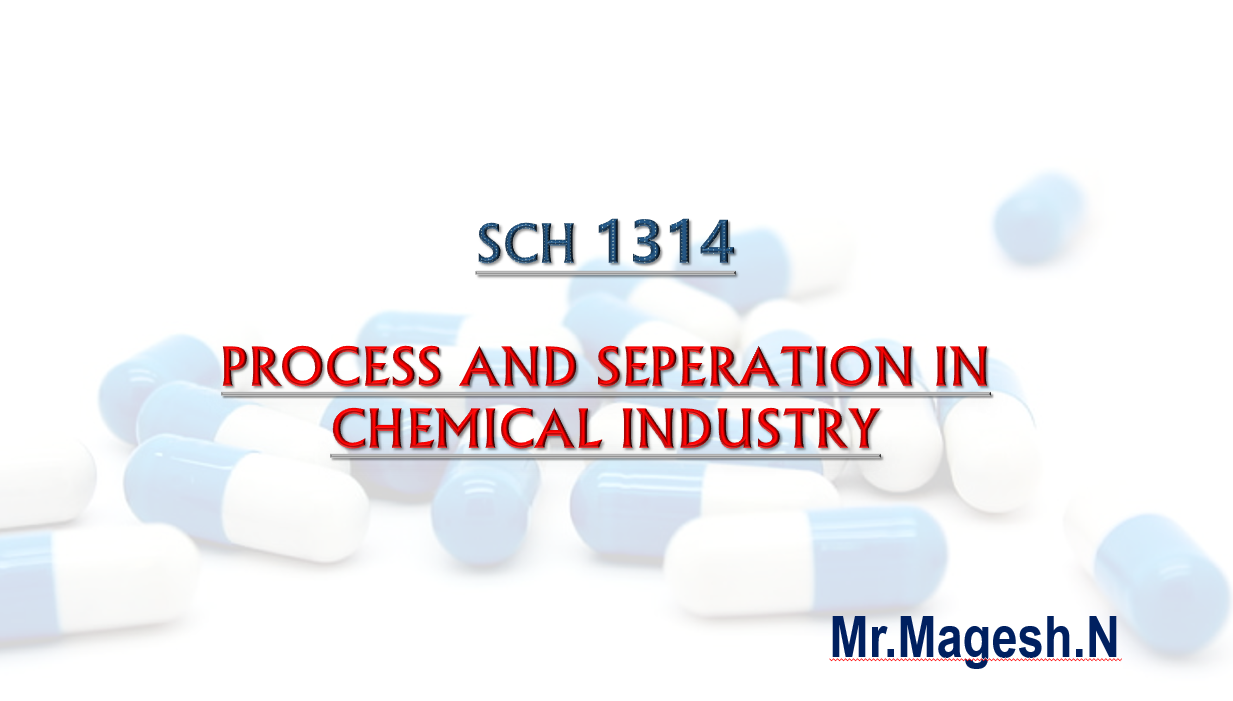
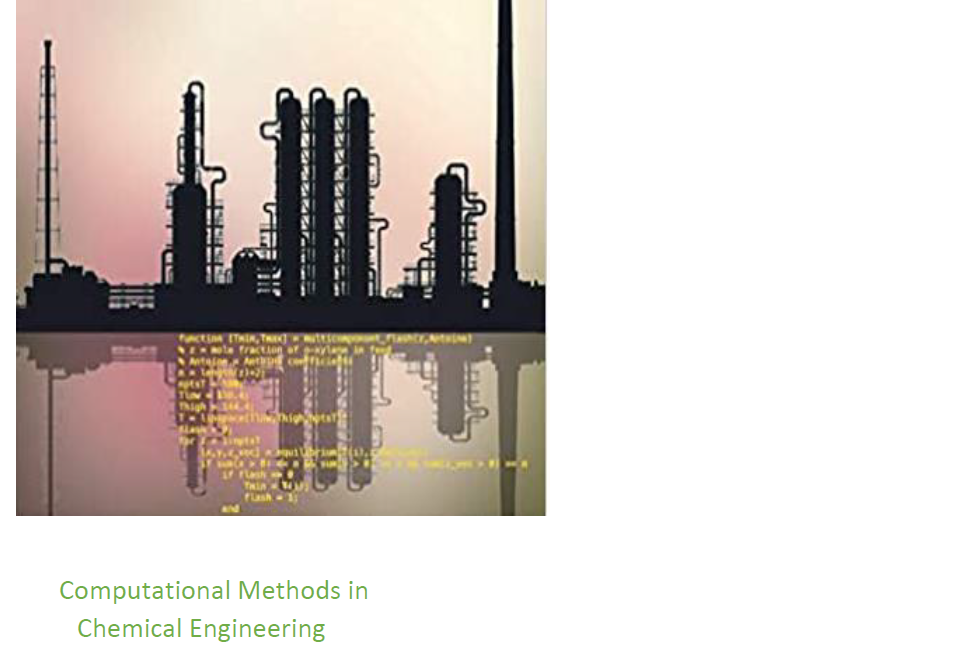
Starting MATLAB,Help, Simple, Functions, Output, Algebra Vectors, Graphs, Interrupting, Syntax, Suppressing Output, Defining Matrices, Size of Matrix, The Identity Matrix, Specialized Matrices ,Diagonal Matrices, The ,Manipulating Matrices, Matrices, matrix Multiplication, String Arrays, Printing Output,MATLAB Scripting Language: M-File MATLAB Search Path, Path Management, and Startup ,File, Function, Errors.
FORMULATION OF PHYSICAL PROBLEMS
Mathematical statement of the problem, Representation of problems, Formulation on extraction in single & multiple stages, Radial heat transfer through a cylindrical conductor, salt accumulation in stirred tank.
INITIAL VALUE PROBLEMS
Initial value problems for ordinary differential equations-Euler’s method, Trapeziodal method, Runge Kutta methods for second and fourth order , interpolation, Newton-cotes integration, Gaussian quadrature.
NUMERICAL OPTIMIZATION AND PARAMETER ESTIMATION TECHNIQUES
Methods for constrained and unconstrained optimization- Lagrangian methods, Simplex, Newton line search method, Trust region Newton method, Single response linear regression, least square regression, Applications- Fitting a kinetic rate law to time dependent data.
BOUNDARY VALUE PROBLEMS
Introduction to boundary value problems, shooting method, finite difference method, finite volume method, finite element method. Applications of BVP-Chemical reaction and diffusion in a spherical catalyst, finite differences for a convection, diffusion equation.
- Teacher: Venkatesan D
Category: ODD SEMESTER
Chemical reaction engineering is that engineering activity concerned with the exploitation of chemical reactions on a commercial scale.
Its goal is the successful design and operation of chemical reactors, and probably more than any other activity it sets chemical engineering apart as a distinct branch of the engineering profession.
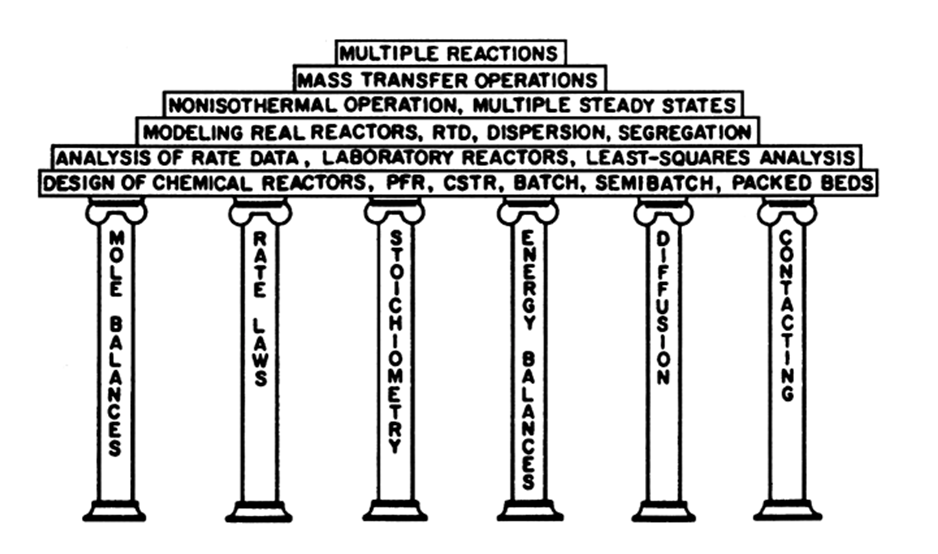
Pillars of the temple of chemical reaction engineering
Category: ODD SEMESTER
Optimization
is
the act of achieving the
best possible
result
under given circumstances.
Primary objective may not
be optimize
absolutely but to compromise effectively &thereby produce
the best formulation
under a
given set of
restrictions.Comprises Optimization Procedure, Methods of optimization, identifying objective and continuous functions, analyzing constrained and unconstrained limit values, employing numerical methods to solve the optimization problems and finally applications of optimization technique to solve chemical engineering problems.

Category: ODD SEMESTER
Optimization is an act of achieving the best possible solution for a given problem.
involves objective functions. constraints with equality and inequality symbols,
techniques to solve the equality and inequality constraints, solving the optimization problems through various numerical and analytical methods
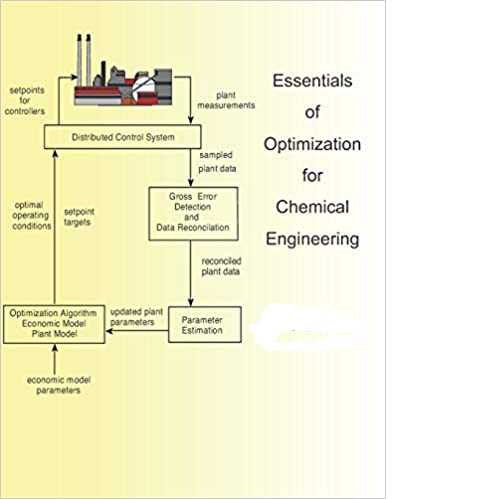
application of optimization in chemical engineering process plants
- Teacher: Sathish S
Category: ODD SEMESTER
COURSE OBJECTIVE
- Exposing to the techniques and capabilities in MATLAB will enhance your ability to use computing tools and
languages to solve engineering problems
- Teacher: Rajalakshmi G
- Teacher: Krishnamoorthy N R
Category: ODD SEMESTER
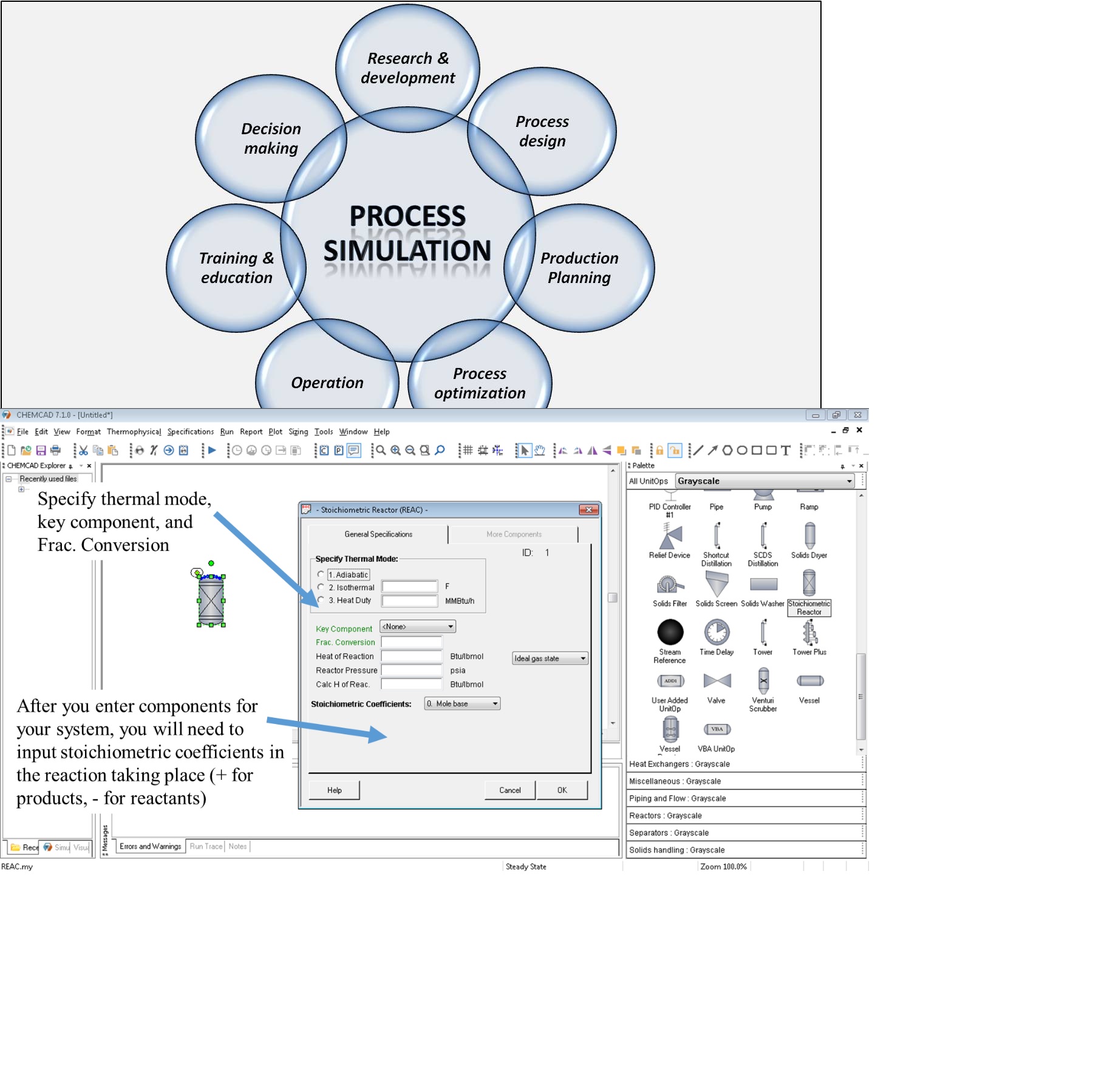
Chemical Engineering Process Simulation is ideal for students, early career researchers, and practitioners, as it guides you through chemical processes and unit operations using the main simulation software’s that are used in the industrial sector. Users can model and simulate chemical reactions, focusing on thermodynamics, equilibrium, kinetics, and acid–base titrations, with accompanying virtual lab exercises.
Applications for this include design studies, engineering studies, design audits, debottlenecking studies, control system check-out, process simulation, dynamic simulation, operator training simulators, pipeline management systems, production management systems. Steady state, Fluid flow and Dynamic process simulator.
- Teacher: Venkatesan D
Category: ODD SEMESTER
Fluid mechanics is the branch of physics concerned with the mechanics of fluids (liquids, gases, and plasmas) and the forces on them. It has applications in a wide range of disciplines, including mechanical, civil, chemical and biomedical engineering, geophysics, oceanography, meteorology, astrophysics, and biology.
- Teacher: Prabu Deivasigamani
Category: ODD SEMESTER
Fluid mechanics is the branch of physics concerned with the mechanics of fluids (liquids, gases, and plasmas) and the forces on them. It has applications in a wide range of disciplines, including mechanical, civil, chemical and biomedical engineering, geophysics, oceanography, meteorology, astrophysics, and biology
- Teacher: Prabu Deivasigamani
Category: ODD SEMESTER
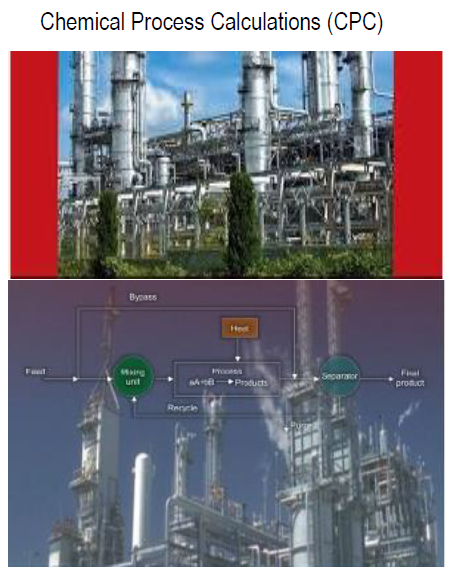
Fundamental concepts, Units and Dimensions, gas relationship, molarity, molality, normality, partial pressure, pure volume and the related calculations. fundamental concepts of material balance. Material balance in various unit processes and unit operations. Material balance with chemical reactions Energy balance related to various process equipment. Calculation of standard heat of reaction from the heat of formation and heat of combustion, thermochemistry, energy balance in various unit operations, the heat of solutions, the heat of neutralization etc. Fuels and combustion calculation, proximate and ultimate analysis, adiabatic reaction temperature, air to fuel ratio, complex processes calculation.
Category: ODD SEMESTER
As chemical engineers, this course will be helpful to understand the processes technologies of various organic and inorganic process industries for manufacturing chemicals and associated troubleshoot. This will give powerful approach in designing new process and product development.
- Teacher: Annam Renita A
Category: ODD SEMESTER