
Search results: 1467
Course Description for SPHB1104 – Physics
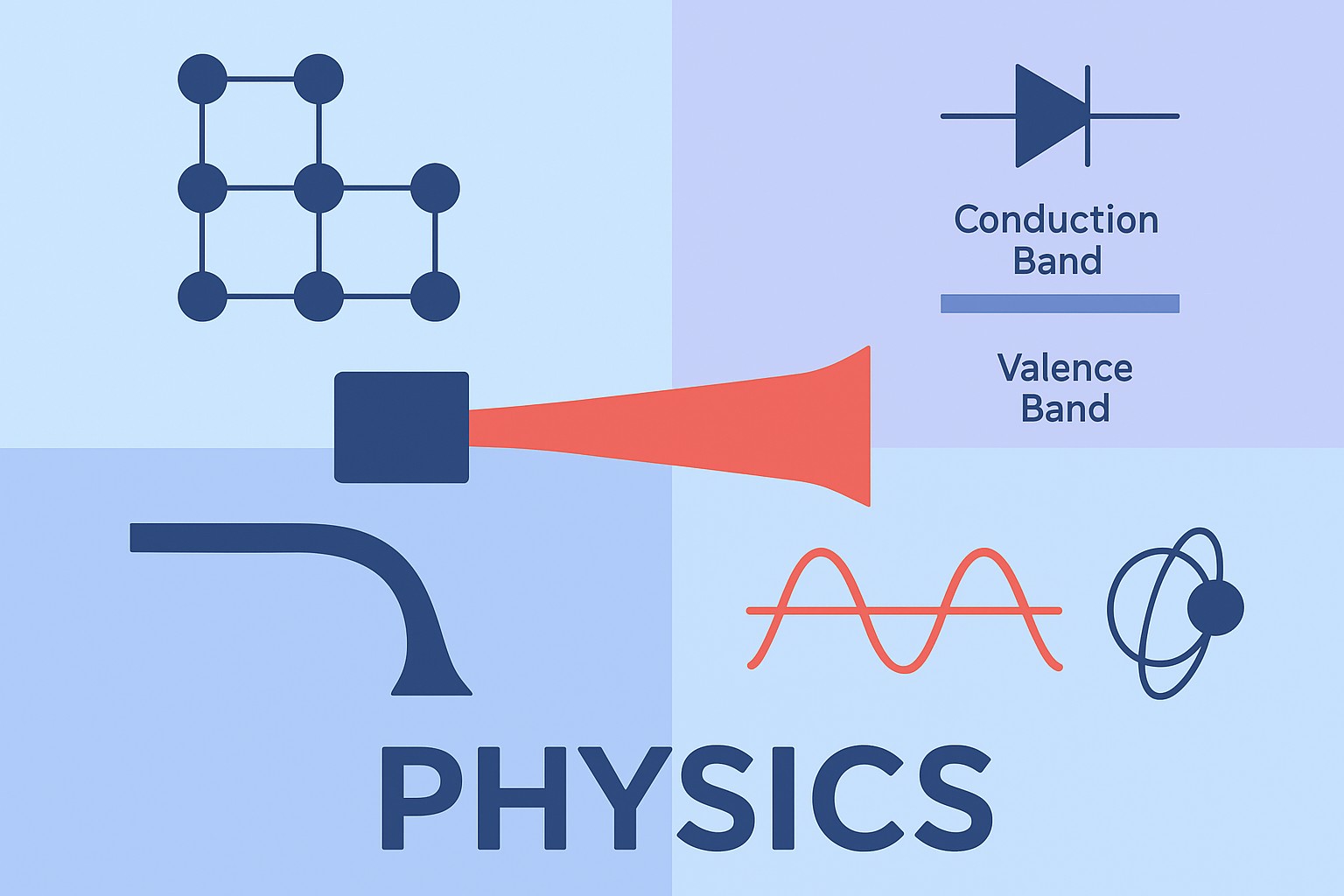
This course introduces engineering students to the fundamental principles of applied physics necessary for understanding materials, devices, and modern technologies. The curriculum covers:
-
Properties of Matter: Elasticity, stress–strain relations, bending of beams, and torsional oscillations.
-
Crystal Physics: Crystal systems, Bravais lattices, Miller indices, packing factors, and crystal growth techniques.
-
Semiconductors & Magnetism: Band theory, p–n junction devices, breakdown mechanisms, and classification of magnetic materials.
-
Quantum Mechanics: Wave–particle duality, Schrödinger’s equation, uncertainty principle, and applications like tunneling and STM.
-
Lasers & Applications: Principles of laser action, diode lasers, quantum cascade lasers, and applications in engineering and medicine.
The associated Physics Laboratory enables hands-on experience in optics, semiconductors, elasticity, fiber optics, and modern physics experiments. Students will gain skills in measurement, data analysis, and application of physical principles to engineering systems.
Learning Outcomes:
By the end of this course, students will be able to:
-
Analyze the elastic properties of solids and determine material constants experimentally.
-
Interpret crystal structures, planes, and defects.
-
Explain semiconductor physics and magnetic materials with device-level applications.
-
Solve fundamental quantum mechanics problems and apply concepts to nanoscale systems.
-
Understand laser principles and evaluate their engineering/medical applications.
- Teacher: Lavanya J
Category: ECE
To understand the basic concepts in static electric field and such as Coulomb’s law and electric potential.
To derive equations for current charges and its applications.
To know about the basic concepts of magnetism and basic laws.
To learn the properties of various circuits are going to be analysed.
To evaluate magnetic concepts and magnetic circuits
To derive equations for current charges and its applications.
To know about the basic concepts of magnetism and basic laws.
To learn the properties of various circuits are going to be analysed.
To evaluate magnetic concepts and magnetic circuits
- Teacher: Jayalakshmi D.S
Category: ODD
- Teacher: Malliga P
Category: School of Science and Humanities
- Teacher: VIJAI ANAND K
Category: ODD
- Teacher: PARASURAMAN K
Category: School of Science and Humanities
Course objective:
- To determine the rigidity modulus of wire
- To find the refractive index of prism
- To understand concept of string
- Teacher: PARASURAMAN K
Category: ODD
- Teacher: Anandhi S
Category: EVEN SEMESTER
Category: EVEN SEMESTER
- Teacher: Kanimozhi D
Category: School of Science and Humanities
- Teacher: DAKSHANA MURUGAN
Category: School of Science and Humanities
The purpose of research is to discover answers to questions through the application of scientific
procedures. The main aim of research is to find out the truth which is hidden and which has not been
discovered as yet. Though each research study has its own specific purpose, we may think of
research objectives as falling into a number of following broad groupings:
1. To gain familiarity with a phenomenon or to achieve new insights into it (studies with this
object in view are termed as exploratory or formulative research studies);
2. To portray accurately the characteristics of a particular individual, situation or a group
(studies with this object in view are known as descriptive research studies);
3. To determine the frequency with which something occurs or with which it is associated
with something else (studies with this object in view are known as diagnostic research
studies);
4. To test a hypothesis of a causal relationship between variables

- Teacher: PARASURAMAN K
Category: ODD
To understand the static electric and magnetic fields in various aspects and relating them using Maxwell’s equations.
Also to study propagation of electromagnetic wave and its interaction with matter.
- Teacher: Rameshkumar C
Category: EVEN SEMESTER
- Teacher: Anita Lett J
Category: EVEN SEMESTER
The course is consists of all non-conventional manufacturing processes. It starts with classification of manufacturing processes and necessity of non conventional manufacturing processes. This course dealt with details about the mechanism of material removal, sources of energy used for material removal, working principle, the set up or equipment and relative advantages and disadvantages. It gives a clear cut idea about the processes, its use in specific industrial application etc.
- Teacher: ARUNKUMAR G
Category: EVEN SEMESTER
(i) to expose the student to the different types of manufacturing available today such as the Special Manufacturing System, the Manufacturing Cell, and the Flexible Manufacturing System (FMS)
Category: ODD SEMESTER